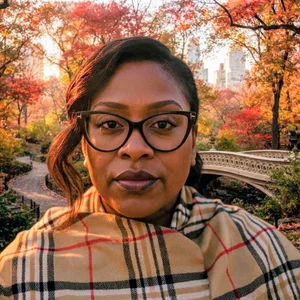
There's a moment in this chair I've had a thousand times.
A client is sitting in my chair, three months into her natural hair journey, and she's holding up a jar of something she picked up at Walmart, online, or her beauty supply store. The label has a beautiful woman on the front. The ingredient list on the back is forty items long, and half of them she can't pronounce.
She looks at me and asks a question. The one I've been asked more times than I can count.
"Ms. April, is this stuff safe?"
And for several years, my honest answer has been the same: "Girlfriend, I can tell you what “I” know. But the truth is, nobody's really made the companies who make the products prove it."
That answer has always sat sideways with me. It sat sideways with my auntie Elvira. It sat sideways with her mother (my grandmother). Now there's a bill sitting in Congress right now that could change what my answer sounds like, and almost none of my clients have heard about it.
Let me tell you what it is, what it would do, and what a licensed cosmetologist with three decades in Type 4 hair thinks about it.
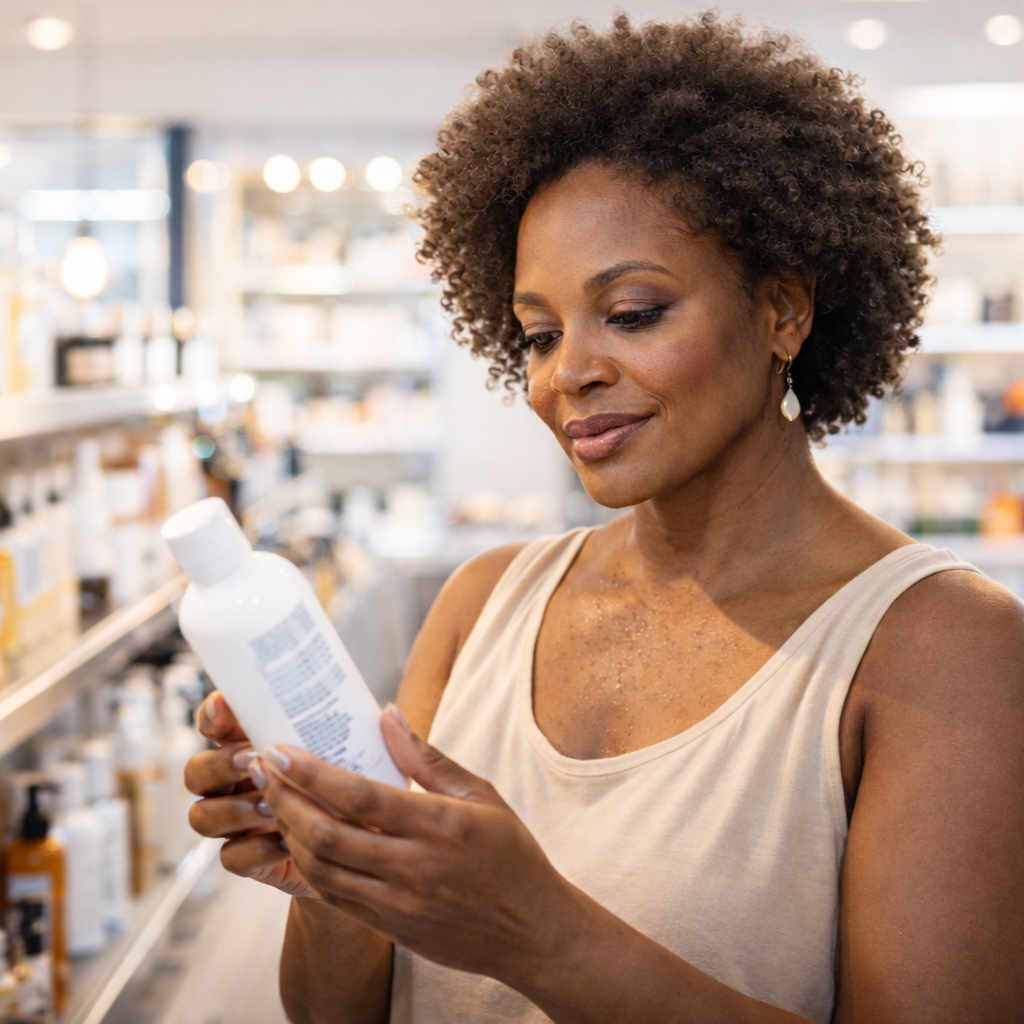
If this looks like a scene you've lived…
You're not alone.
Every Black woman I know has stood in this aisle, holding a bottle, wondering.
Eighty Years of Nobody Watching
Here's a piece of history most women don't know, because nobody ever taught us.
Before 2022, the last time federal law seriously updated how cosmetics were regulated in this country was 1938. Eighty-plus years. The world went through World War II, the moon landing, the internet, and smartphones, and the FDA still had almost no authority over what a company could put in your shampoo.
That changed a little in 2022, when Congress passed something called MoCRA, the Modernization of Cosmetics Regulation Act. That gave the FDA the power to recall products that were hurting people, required companies to register their factories, and started building the first real oversight this industry has ever had.
But it left gaps. Big ones. And the bill I want you to know about is trying to close them.
What the Safer Beauty Bill Package Actually Is
Federal lawmakers reintroduced it in July of last year (2025). It's called the Safer Beauty Bill Package: four separate bills that would work together to do something the industry has been dodging for almost a century.
Here's what the four bills would do, in plain language:
One: Ban the eighteen worst chemicals from cosmetics, the ones that have been linked to cancer, hormone disruption, and reproductive harm.
Two: Force companies to disclose their supply chains, so you and I can actually know where the ingredients came from before they landed in the jar.
Three: Specifically address the fact that Black women and salon workers are exposed to more toxic chemicals than almost any other group in America, and put $30 million toward research and safer alternatives.
Four: Close what's called the "fragrance loophole", the trick where a company can hide up to a hundred different chemicals on a label under one word: fragrance.
That's the bill.
I'm not here to tell you how to feel about Washington. I'm not here to tell you how to vote. That's not what my chair is for. What I'm here to tell you, as a licensed cosmetologist who has watched what these products actually do to women's bodies for thirty years, is this:
Every one of those four bills addresses something I have been watching hurt Black women for my entire career.
The Braiding Hair Piece Nobody's Ready to Talk About
Let me tell you the part of this bill that stopped me cold, in my tracks, when I read it.
For the first time in federal law, the FDA would be directed to oversee the safety of synthetic braiding hair.
Let that marinate in your grain for a second.
Synthetic braiding hair is a multi-billion-dollar industry. It is on the head of nearly every Black woman I know at some point in her life. Little girls. Teenagers. Grown women. It stays on our scalps for weeks, sometimes months at a time. It touches our skin, our hairline, our necks, everywhere it hangs. It’s even in our beds as we sleep.
And it has been almost entirely unregulated.
Recent independent lab testing has found concerning levels of chemicals, including known carcinogens and heavy metals, in the most common braiding hair brands on the market. The brands you and I have been buying at the beauty supply for twenty years. The brands we've been putting on our daughters' heads.
Nobody was watching. Nobody was required to test it. Nobody had to tell us what was in it.
If this bill passes, all of that changes.
What Thirty Years in the Chair Has Taught Me
I want to be straight with you, because I feel that I have earned the right to say what I’m about to say.
I have, on occasion, been mixing chemicals with my bare hands since the mid-1990s. Relaxers. Color. Perms. Straighteners. Products with warning labels I ignored because that was the job and everybody else was doing it, too. Nobody talked about the risks that were adding up in my body.
I have watched clients come to me after twenty years of monthly braids and ask me why their edges won't grow back.
I have watched younger stylists develop breathing problems after two years behind a chair.
I have watched women be told their fibroids, their hormone issues, their scalp conditions were "just genetic," while the science has been quietly building for a decade suggesting that some of it isn't just genetics at all.
I am not a doctor. I don't diagnose. But I have hands, and my hands have memory.
When I hear about a bill that would finally require the manufacturers to prove their products are safe before they land on my station, instead of the current arrangement, where the harm has to show up in enough women's bodies before anyone is forced to look. That isn't political to me. That's professionalism that is overdue.
What Happens If the Bill Passes? What Happens If It Doesn't?
Here's the honest truth about federal legislation… it moves slowly.
This same bill package has been introduced before. And before that. It's been fighting for airtime since 2021. It may pass this session. It may not. It may pass in pieces. It may get watered down. It may get stuck in a committee and sit for another two years. Who knows?
I'm telling you this because I don't want you to hear "there's a bill" and think somebody in Washington is about to solve this for you. Maybe they will. Maybe they won't. Either way, the shelves at the beauty supply look the same tomorrow as they did today.
So I'm not waiting.
And I don't want you waiting either.
What You Can Do This Week, With or Without a Bill
Whether this bill becomes law next month or five years from now, here's what belongs in your hands right now:
Learn to read your own labels. You don't need Congress to tell you what's in your jar. You need to know how to read what's already there. The first three ingredients are the majority of the product. Look at those first. If the top of the list is water and a couple of things you recognize, that's usually a better sign than a top of the list full of things you can't pronounce.
Watch for the fragrance line. Until the loophole closes, "fragrance" or "parfum" on a label can hide dozens of chemicals. If you're sensitive, pregnant, or trying to reduce your chemical load, look for products that spell it out; "essential oil blend of lavender and cedarwood" tells you something. "Fragrance" tells you nothing.
Rethink your braiding hair. There are pre-detox rinses that reduce the chemical coating on synthetic hair; an apple cider vinegar and warm water soak before you install it can pull out a surprising amount of what's sitting on those fibers. There are also plant-based synthetic braiding hair options coming to market that are worth learning about.
Give your scalp regular breaks. Whatever's on your head, from products to extensions, your scalp deserves time to experience the open air. Do this between styles, between installations, and between chemical services.
Do a full ingredient audit once a year. Pull every product off your shelf or out of your cabinets. Read every label. Anything you wouldn't buy today, retire it.
That last one is the whole practice, right there.
The Garden Doesn't Wait on the Government
If you've been with me a while, you know I believe your hair is not a problem to fix. It's a garden to tend.
A gardener doesn't wait for the county to tell her the soil is contaminated. She tests the soil. She learns what's in it. She decides what she's planting. She becomes her own agriculture department, because nobody else is going to care about her plot the way she does.
Your crown is your plot.
Congress may or may not update the rules on what can be sold to you. But what you buy, what you use, and what you put on your scalp… those decisions have always been yours. And they're yours today. And they're yours next month.
That's the whole S.A.N.D. Method™ in one line: Scalp & Spirit, Age-Appropriate Actives, Nutrient Layering, Deep Defense. Defense starts with what you refuse to put on your head in the first place.
One More Thing Before You Go
Thirty years behind the chair have taught me that Black women have been the first row of the garden, the row that took every hard frost while the rest of the field got protected. We were sold the harshest products. We were told they were normal. We were told the side effects were us.
They weren't.
And whether or not any bill passes in Washington, the truth is being written down now - in lab tests, in legal filings, in the pages of newspapers, and in the memory of every woman who ever wondered if what she was putting on her head was quietly costing her something.
You deserved better information. You get to have it now.
Take the Next Step
Before you buy one more product, run it through Crown Decode™, my free ingredient decoder built specifically for Type 4 hair. Drop in what's on the label. I'll walk you through what belongs on your scalp and what doesn't, using the 3-Pass Method™ I use when I’m shopping for hair products.
You don't need to wait on Washington. You can start reading your labels today.
→ Try Crown Decode™:crown-decode.onrender.com
If you want to keep learning, real conversations about natural hair, the lessons from thirty years in this chair, and everything I wish somebody had taught us sooner, join me on YouTube.
→ Blooming with Ms. A on YouTube: @bloomingwithmsa
And if you're in the Dothan, Kinsey, or Wiregrass area and want me to walk you through the products you currently own, in person, that's what my chair is for.
→ Book a consultation @ Studio HME:studiohme.as.me
Healthy Hair. Intentional Care.
— Ms. April
Where I Got My Facts
I'm not a journalist. I'm a licensed cosmetologist. But when I write about something this serious, I want you to be able to check my work — and dig deeper if you want to. Here's where the facts in this post came from:
On the Safer Beauty Bill Package (July 2025)
The official announcement from Rep. Jan Schakowsky, who leads the bill package with Reps. Fletcher, Matsui, and Pressley.
→ schakowsky.house.gov
On why this bill matters for Black women
Breast Cancer Prevention Partners has been leading the fight for safer beauty for over a decade. Their overview of the bill package.
→ bcpp.org
On the synthetic braiding hair testing
The Consumer Reports study I referenced. They tested 10 popular brands and found carcinogens in 100% of samples, lead in 9 of 10, and VOCs across the board. They're calling on the FDA to regulate this industry.
→ advocacy.consumerreports.org
On MoCRA (2022) — the law this bill builds on
The FDA's own overview of the Modernization of Cosmetics Regulation Act.
→ fda.gov